Ingredient · Nutraceutical
Vitamin E supplement manufacturer in India
At Vynza, we manufacture Vitamin E into tablets, capsules, syrups and oral liquids, oral drops, powders, sachets, stick packs for brands at our facility in Mohali, Punjab, and it appears in 53 of our ready formulations.
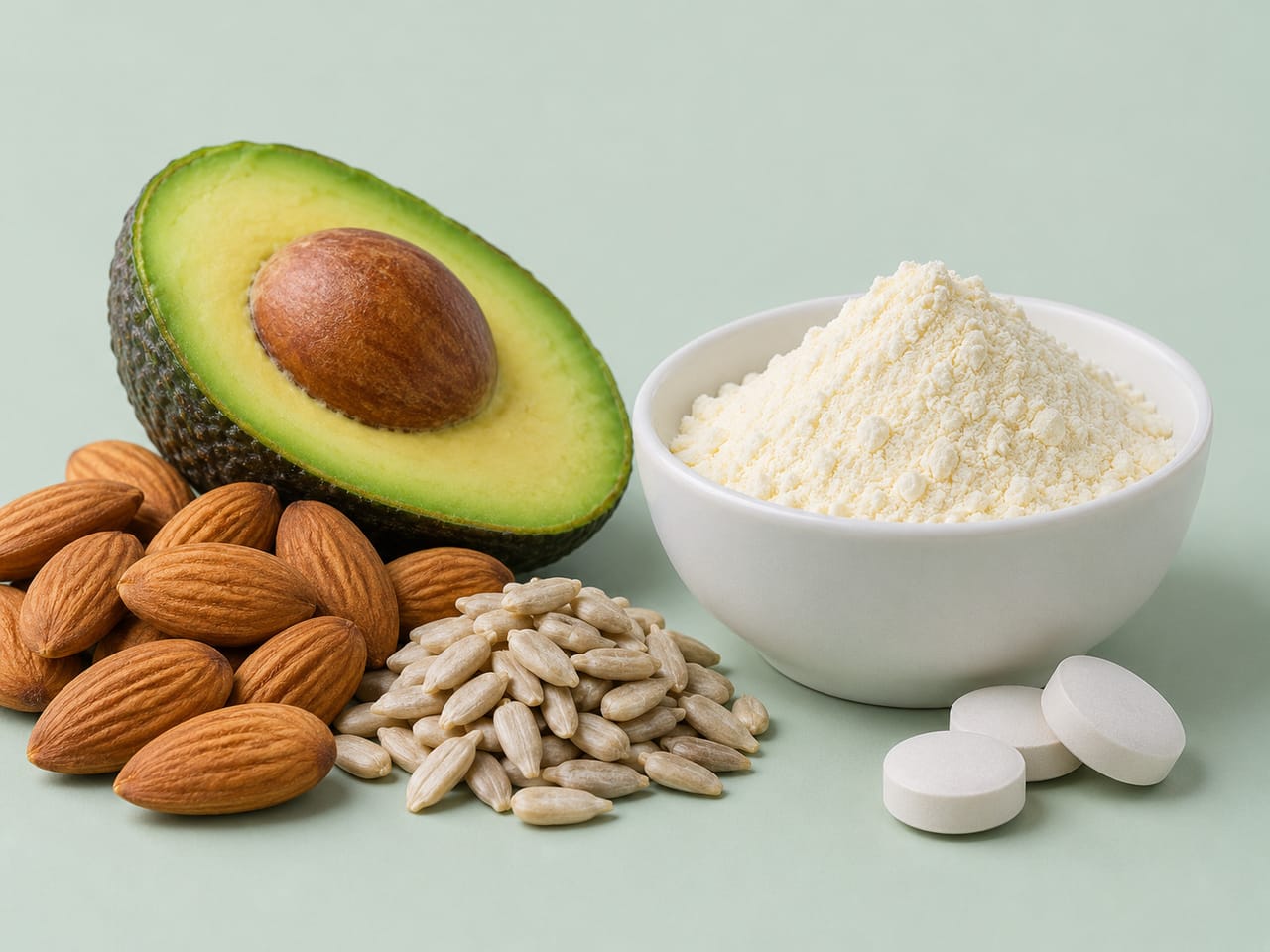
- Ingredient
- Vitamin E
- Licence track
- Nutraceutical (FSSAI)
- Dosage forms
- Tablets, Capsules, Syrups and oral liquids, Oral drops, Powders, Sachets, Stick packs
- FSSAI schedules
- Schedule I, entry 9
- In our library
- 53 formulations
What Vitamin E is
Vitamin E is a group of fat-soluble antioxidants, supplied in supplements as natural d-alpha-tocopherol, mixed tocopherols or synthetic dl-alpha-tocopheryl acetate. It sits in cell membranes, where it supports the protection of cells from oxidative stress. We use it in multivitamin, skin, hair, eye, fertility and paediatric ranges, often alongside vitamin C and selenium.
Vitamin E and the regulations
Our nutraceutical products are made under FSSAI’s 2016 Health Supplements and Nutraceuticals Regulations, as operationalised through FSSAI’s 2022 directions (latest re-operationalisation 30 August 2024, under Section 16(5)).
Vitamin E is listed by name, as Vitamin E (D-alpha-tocopherol), in Schedule I (nutrients), entry 9, of the schedules set out in FSSAI’s direction of 18 October 2022 (page 17).
Used in health supplements and nutraceuticals made under FSSAI, in a form from the permitted vitamin list. Isolated vitamins are not used in Ayurvedic products made under AYUSH.
Dosage forms we make Vitamin E in
Tablets, Capsules, Syrups and oral liquids, Oral drops, Powders, Sachets, Stick packs.
Natural vitamin E is an oil, so tablets and powders use the acetate as a dry powder on a carrier. Syrups and drops need an emulsified or water-dispersible grade.
Choosing your Vitamin E grade
Natural d-alpha-tocopherol, from soybean or sunflower oil, and synthetic dl-alpha-tocopheryl acetate are the two main families. Natural forms carry greater biological activity per unit and suit natural positioning, while synthetic acetate is stable and widely used in tablets. Mixed tocopherols and tocotrienols from palm or rice bran are requested for specialised antioxidant ranges. Dry powder grades on starch or acacia carriers suit tablets and sachets, and oil or water-dispersible grades suit drops and syrups. Soy-derived grades need an allergen check.
Vitamin E on the label
Declared by its exact form, such as d-alpha-tocopherol or dl-alpha-tocopheryl acetate, with the daily amount within the ICMR-NIN recommended dietary allowance. Check powder grades for gelatin before choosing the vegetarian symbol.
How brands use Vitamin E
Vitamin E pairs naturally with vitamin C and selenium as an antioxidant trio. Our Eye Antioxidant Max tablet uses it in an eye formula, and the Daily Multivitamin (Adult) includes it in the full vitamin panel. Skin and hair products use it for beauty positioning, and fertility formulas for men and women often include it. Buyers are direct-to-consumer beauty brands, fertility clinics with own-label packs, eye care pharmacy brands and paediatric drop brands.
Our formulations with Vitamin E
- Pediatric Multivitamin Drops with Iron (VZ-PD-002) · Oral drops
- Pediatric Multivitamin Drops with Iodine (VZ-PD-003) · Oral drops
- Pediatric Multivitamin Drops with Folic Acid (VZ-PD-004) · Oral drops
- Mg + Carnitine Combo (VZ-BJ-045) · Tablets
- UC-II® with Citrulline (VZ-BJ-054) · Capsules
- Eye Antioxidant Max (VZ-EC-001) · Tablets
- Eye Care (VZ-EC-002) · Tablets
- Adaptogenic Energy (VZ-IM-001) · Capsules
- Complete Immunity MVM Lichen-D3 (VZ-IM-006) · Tablets
- Daily Multivitamin (Adult) (VZ-IM-008) · Tablets
- Immunity Support Tablets (VZ-IM-011) · Tablets
- Immunity Support Capsules with Vitamins C and E (VZ-IM-012) · Capsules
- Fertility Mg + E (VZ-MH-004) · Tablets
- Lycopene + Se + Zn Tablet (VZ-MH-008) · Tablets
- Male Fertility Omega (VZ-MH-012) · Tablets
- Male Performance (VZ-MH-013) · Tablets
- Sperm Vitality Antioxidant (VZ-MH-016) · Tablets
- Beauty Carotenoid MVM (VZ-SH-001) · Capsules
- Biotin Collagen Amla (VZ-SH-002) · Tablets
- Complete Hair + Skin + Nail MVM (VZ-SH-003) · Tablets
- Hair Nail Mineral (VZ-SH-008) · Tablets
- Menopause Soya Complex (VZ-SH-011) · Tablets
- PCOS Support with NAC (VZ-SH-012) · Tablets
- Omega 3 + MVM Syrup (VZ-NB-016) · Syrups and oral liquids
- Pediatric Anaemia Support Syrup with Multivitamins (VZ-PD-013) · Syrups and oral liquids
- Pediatric Anaemia Support Syrup with Soy Protein (VZ-PD-015) · Syrups and oral liquids
- Pediatric Anaemia Support Syrup with Amino Acids (VZ-PD-016) · Syrups and oral liquids
- Pediatric Appetite Tonic with Soy Protein (VZ-PD-021) · Syrups and oral liquids
- Pediatric Immunity (VZ-PD-024) · Syrups and oral liquids
- Pediatric Multivitamin Syrup with Calcium (VZ-PD-025) · Syrups and oral liquids
- Pediatric Multivitamin Syrup with Selenium (VZ-PD-026) · Syrups and oral liquids
- Pediatric Multivitamin Syrup (VZ-PD-027) · Syrups and oral liquids
- Pediatric Trace Mineral Syrup with Calcium (VZ-PD-029) · Syrups and oral liquids
- Pediatric Trace Mineral Syrup with Vitamin B12 (VZ-PD-031) · Syrups and oral liquids
- Pediatric Trace Mineral Syrup with Biotin and Selenium (VZ-PD-032) · Syrups and oral liquids
- Algae Protein MVM with Krill Oil (VZ-PD-033) · Powders
- Spirulina MVM Powder (VZ-PD-034) · Powders
- Algae Protein MVM (VZ-PD-035) · Powders
- Algae Protein MVM with Amino Acids (VZ-PD-036) · Powders
- Kids Nutrition Powder with Protein (VZ-PD-037) · Powders
- Kids Nutrition Powder with Protein (VZ-PD-038) · Powders
- Kids Nutrition Powder with Vitamin K1 (VZ-PD-039) · Powders
- Kids Nutrition Powder with Manganese (VZ-PD-040) · Powders
- Kids Nutrition Powder with Protein (VZ-PD-041) · Powders
- Kids Nutrition Powder with Protein (VZ-PD-042) · Powders
- Kids Nutrition Powder with Protein (VZ-PD-044) · Powders
- Kids Nutrition Powder with Calcium and Phosphorus (VZ-PD-045) · Powders
- Kids Nutrition Powder with Evening Primrose (VZ-PD-046) · Powders
- Kids Nutrition Powder with Choline (VZ-PD-047) · Powders
- Protein Iron-Folic MVM (VZ-PD-048) · Powders
- Protein Iron-Folic MVM with Taurine (VZ-PD-049) · Powders
- Protein Iron-Folic MVM with DHA (VZ-PD-050) · Powders
- Weight Management Shake (VZ-SN-005) · Sachets
Often paired with Vitamin E
Check the vitamins and minerals in the same formula with our FSSAI formulation checker, or browse all ingredients: Vitamin D · Vitamin K1.
FAQ
Questions about Vitamin E
Which dosage forms can you make Vitamin E in?
Tablets, Capsules, Syrups and oral liquids, Oral drops, Powders, Sachets, Stick packs. We confirm the format that suits your dose, taste and pack at proposal stage.
Is Vitamin E allowed in products made in India?
Vitamin E is listed by name, as Vitamin E (D-alpha-tocopherol), in Schedule I (nutrients), entry 9, of the schedules set out in FSSAI’s direction of 18 October 2022 (page 17).
Which of your formulations use Vitamin E?
Pediatric Multivitamin Drops with Iron (VZ-PD-002), Pediatric Multivitamin Drops with Iodine (VZ-PD-003), Pediatric Multivitamin Drops with Folic Acid (VZ-PD-004), Mg + Carnitine Combo (VZ-BJ-045), UC-II® with Citrulline (VZ-BJ-054), Eye Antioxidant Max (VZ-EC-001), and 47 more listed on this page.
What is Vitamin E usually combined with?
In our library it is most often paired with Vitamin C, Zinc, Vitamin A, Vitamin B6.
Can you work with a specific Vitamin E grade or a branded ingredient?
Yes. Tell us the grade, standardisation or branded ingredient you want. For a branded grade we source the genuine branded ingredient from the brand owner or its distributors, with the brand’s certificate of analysis.
How fast can you make a product with Vitamin E?
A formulation proposal within 48 hours, a bench sample within 10 days of a signed brief, and dispatch within 30 days of artwork and advance approval for a standard batch.
Make your Vitamin E product with us.
Tell us the format and the customer; we reply with a formulation proposal within 48 hours.
Updated on