Capsule line at a glance
- Shells
- Hard gelatin; HPMC (vegetarian)
- Fills
- Powders, granules and pellets
- Typical actives
- Botanical extracts, probiotics, branded ingredients, vitamins and minerals, Ayurvedic extracts
- Shell colour
- Chosen during development and approved with the bench sample
- In-process checks
- Fill weight, weight variation, appearance, disintegration
- Batch release
- Identity, assay, moisture, microbial and heavy-metal testing; certificate of analysis
- Packing
- Bottles and jars with induction seal and batch coding; blister and strip packing
- Timeline
- Proposal 48 hours · bench sample 10 days · dispatch 30 days from artwork and advance approval
Capsules we manufacture
We fill them from our 350+ ready formulations or your own formula, and we manufacture with branded ingredients such as KSM-66®, Curcumin C3 Complex®, UC-II® and Pycnogenol®. We source the genuine branded ingredient from the brand owner or its distributors, with the brand’s certificate of analysis.
- HPMC capsules for vegetarian and vegan products, and for brands that want a plant-based shell on the label.
- Hard gelatin capsules for products where a vegetarian shell is not needed. Gelatin is of animal origin, so the pack carries the non-vegetarian symbol that Indian food labelling requires.
- Powder and granule fills for botanical extracts, vitamins, minerals and amino acids.
- Pellet fills for actives that need a coated or modified-release bead inside the shell.
- Branded-ingredient capsules with branded ingredients such as KSM-66® ashwagandha and Curcumin C3 Complex®, at the doses those ingredients are referenced at.
- Ayurvedic capsules of standardised extracts and proprietary herbal blends, made to AYUSH-GMP standards.
When a capsule is the right format
Capsules suit actives that taste bitter or smell strong, extracts that do not compress well, probiotics that should not be pressed or heated, and formulas where customers expect a short, simple ingredient list. A capsule needs fewer excipients than a tablet, but it holds less per unit, so a high-dose formula may need two or three capsules per serving. We show you that trade-off in the proposal, and where the serving gets too large we suggest a tablet or a powder instead.
How we make a capsule
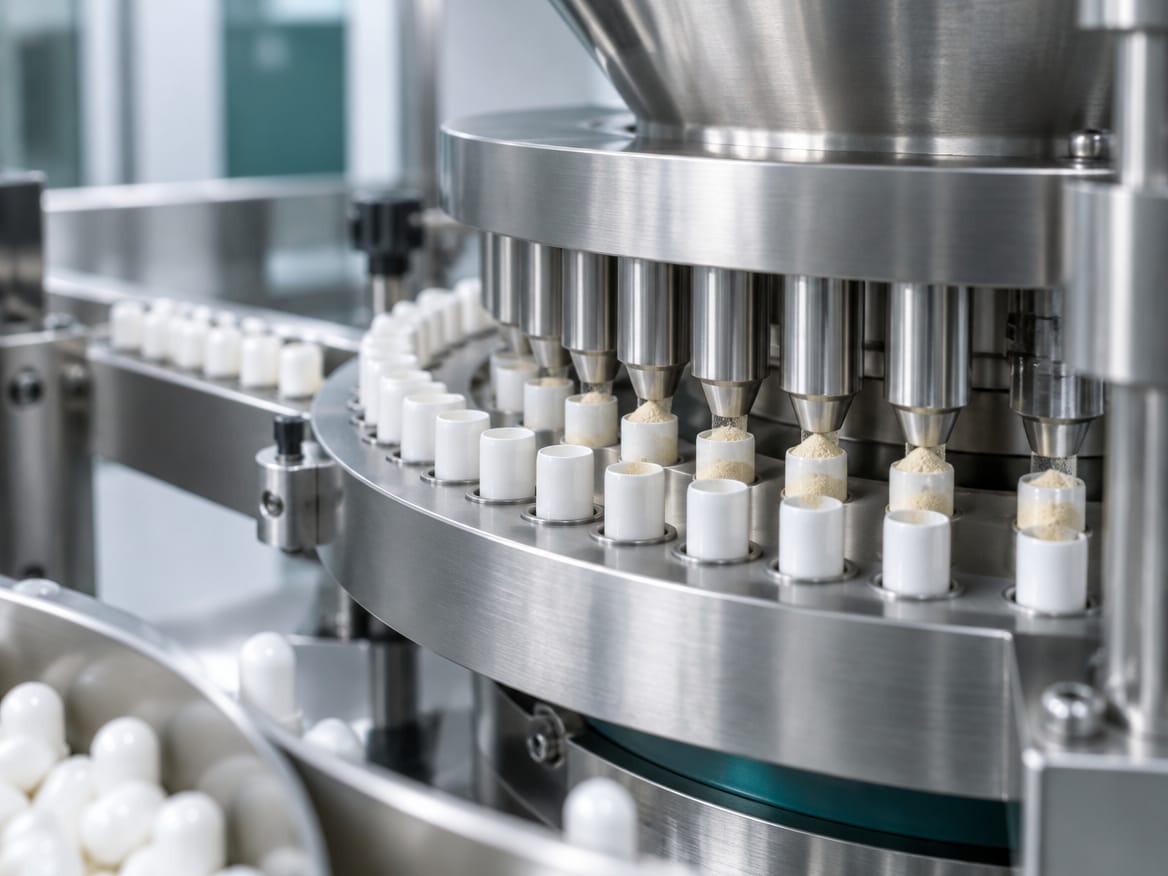
We dispense and sift the actives and excipients, blend them to a uniform fill and set the fill weight to the dose. Capsules are filled and closed, then checked for weight variation, appearance and disintegration through the batch. The finished batch is released on identity, assay, moisture, microbial and heavy-metal testing, with a certificate of analysis. Hygroscopic fills, such as some extracts and probiotics, are handled in humidity-controlled conditions and packed to limit moisture pick-up.
Shell size is chosen to fit the fill weight and density of your formula. If a dose would need a capsule larger than customers find comfortable, we tell you at proposal stage and suggest two capsules per serving or a denser fill.
Packaging and labelling
Capsules are filled into bottles and jars with induction seals and batch coding, and cartoned with your artwork after a label review against FSSAI rules. The label states the dose per capsule and per serving, the vegetarian or non-vegetarian symbol that matches the shell, and the advisory statements nutraceutical labels must carry.
From brief to dispatch
A formulation proposal within 48 hours, a bench sample within 10 days of a signed brief, and dispatch within 30 days of artwork and advance approval for a standard batch. Browse the capsule formulations in our library, or check your own formula first with our FSSAI formulation checker. Each is available as white label or adjusted to your plan as private label, under our contract manufacturing service.
Updated on